As a companion piece to my last article about how to find new music in the age of AI, I thought it might be worth doing one that looks at this from the other side of the ledger. So bands and artists, read on.
Let’s face it. There has never been an easier time to put together a music project that looks vaguely professional. You can generate artwork in seconds, write a biography without actually writing anything, and produce promotional photographs of people who don’t really exist. You can even ask your AI mate to create social posts by the hundred and, if you’re really not a creative at all, generate the actual music as well.
I’m not here to tell you not to use AI at all. It can be useful for minor, menial tasks that you otherwise wouldn’t have the time for. But it does create an absolutely infuriating problem for genuine artists: When it’s easy to look polished and professional, being polished and professional stops being impressive.
If you’re an up-and-coming musician trying to get noticed, the answer almost certainly isn’t to produce more content than the machines. Instead, you should focus on giving people a reason to believe there’s an actual human behind that content. Preferably one with an interesting story to tell.
Be specific
AI is remarkably good at producing things that are somewhere in the general ballpark of what people are looking for. But it tends to do that by making incredibly generic things. If you’ve ever wondered if something’s AI, it probably is. Because AI makes things that sound like absolutely everybody else.
Read enough automatically generated artist biographies, and you’ll encounter an endless procession of musicians who are “pushing boundaries”, “blending genres”, “drawing on a diverse range of influences” and creating music that is somehow both “deeply personal” and “universally relatable”. None of that tells you anything, but specificity does.
Tell people that you made the record above a takeaway in Huddersfield. Tell them the guitar sound happened because you spilt beer on one of your pedals. Talk about the awful gig where seven people turned up, four of whom were in the other band. Your actual story is one of the few things nobody else can generate. So use it!
Let people see the process
As an artist, there’s always a temptation to only show the finished version: The mastered single, the professionally shot photograph, the carefully edited video from the biggest gig you’ve played. Of course those things have their place.
But they’re also increasingly easy to fake. The scruffier material can be much more convincing.
Show rehearsals and songwriting. Show the ridiculous collection of pedals you’ve convinced yourself are essential. Post ten seconds from a tiny venue with no punters, where the camera microphone is being thoroughly obliterated by the drummer.
Not everything needs to be “content”. Sometimes evidence that you’re actually doing the thing is WAY more interesting than another cookie-cutter promotional graphic announcing that the thing exists.
Play live
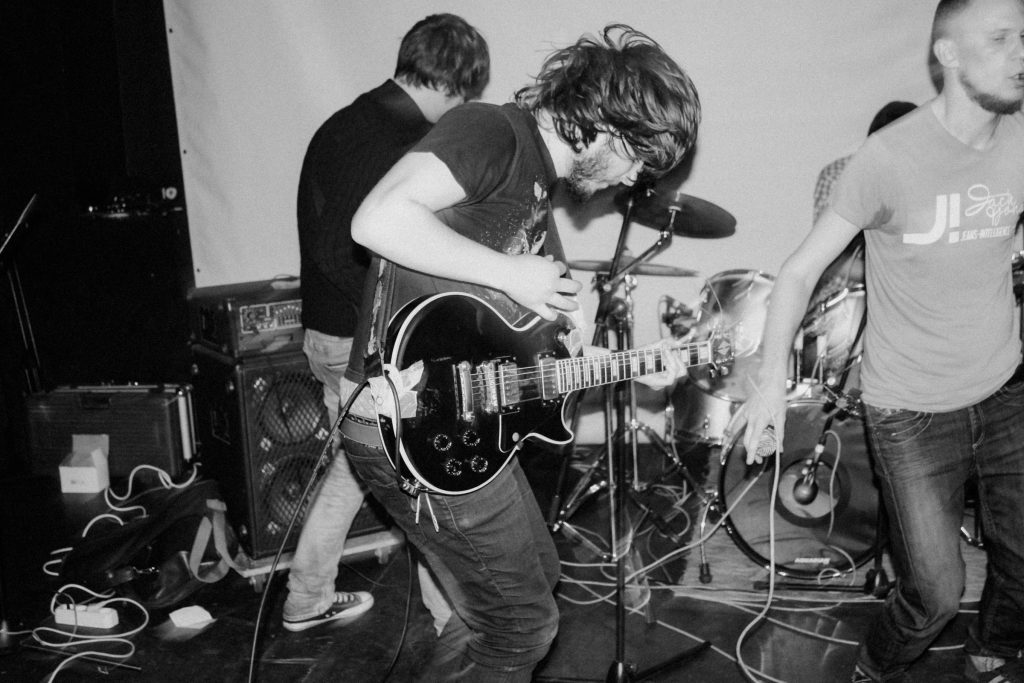
Ah, the holy grail of the real band. AI can make music, images of musicians, videos, and posters. What it can’t do is walk into your local 150-capacity venue on a Wednesday night and play an occasionally brilliant set.
Live music creates something that digital promotion can never really replicate: witnesses. Someone sees you. They tell somebody else. They follow you. They buy something. They turn up next time with a friend.
While getting people through the door is rarely easy, playing regularly also connects you to other bands, promoters, photographers, venues and local audiences, and that’s where your next gig (and if you’re lucky, a support slot at a bigger venue) will come from. Those relationships matter considerably more than 5,000 anonymous video views ever will.
Oh, and make your own posters. A hand-drawn, crappy poster for a real band looks a hundred times more enticing than yet another AI slop poster with that horrible yellow piss sheen and faux paint-brush stroke text background that the current algorithms slop onto everything.
Give yourself somewhere permanent online
Social media is useful, but you are always at risk when playing in someone else’s playground. What if your chosen social media platform kicks you off for your ethically correct but socially unacceptable views? What if people start drifting away from that social network and you lose all of your followers? Or what if your chosen social network gets bought out by a narcissistic nutjob with fascistic tendencies and a penchant for platforming racist content?
Algorithms change, platforms disappear, accounts get restricted, and features come and go. The thing you’re told every musician absolutely needs to be doing this year will almost certainly be replaced by something else next year.
Having your own website gives you one place that is actually yours.
It doesn’t need to look anything like the website of a multi-platinum selling artist. For most independent artists, a few good pages covering your music, upcoming shows, biography, photographs, videos and contact details will do the job perfectly well. And don’t panic: it doesn’t need to cost a fortune. Locally to me, there’s a guy called Steve (Hexagon Digital) who does freelance web design, including for local bands. Someone like him can put together something relatively simple that brings everything together for a completely reasonable cost.
What websites also do is establish a history. Previous releases remain visible, old gigs can be referenced, reviews can be linked, and photographs can accumulate. Someone discovering you for the first time has somewhere to explore rather than encountering six Instagram posts and a streaming profile. In an increasingly synthetic internet, having a real footprint matters.
Don’t forget Bandcamp
Streaming services are obviously important. That’s where a huge proportion of people listen to music, and pretending otherwise isn’t particularly useful. But Bandcamp offers something different. It gives interested listeners somewhere to go beyond simply adding one track to a playlist.
Put your records there, add proper credits, and write up an interesting blurb. Sell physical copies if you have them. Offer downloads. Make the page feel like it belongs to you, rather than being just another entry in a database containing several million other artists.
The people who actively explore Bandcamp are also doing something valuable: they’re looking for music (and not any of that AI rubbish either; these are proper music fans). That’s a rather different audience from someone who happened to hear 25 seconds of your song because an algorithm placed it between two others.
Stop trying to look enormous
This might be the biggest one. Small bands have spent years trying to look bigger than they are. While there’s nothing inherently wrong with professionalism, the internet is becoming saturated with artificial scale: enormous-looking campaigns for things nobody has heard of, generated audiences, inflated numbers and promotional material that looks expensive without actually saying anything.
Being obviously independent can now actually be an advantage:
Are you a band from Leeds playing to 80 people? Great! Tell us why those 80 people had a good night.
Have you pressed 100 records rather than 10,000? Brilliant. Number them and give people a rundown as each of them sells (and sign them at your merch stand).
You’re recording an EP yourself because you can’t afford Abbey Road? Show us the room.
The best way to be real is to tell the truth about who you are. That’s your angle, so use it.
Make things people can care about
The abundance of AI-generated music is definitely not going to stop real music fans from listening to human musicians, but it probably will make completely generic music and promotion even easier to ignore. That’s the useful bit.
There’s no point playing the AI slop-machine at its own game, and churning out low-effort content like it’s going out of fashion. So make your content count. Go for quality and personality over quantity. Give your audience (and potential audience) songs, gigs and stories to remember. Give them something real to hold onto in this age of mega stars hogging all of the money in media.
Technology can imitate a remarkable number of things, but it can’t be you.